"/>
Enterprises and operators were juggling isolated n8n nodes, brittle webhook scripts, and uncoordinated voice bots with no unified telemetry or shared execution state.
As modern businesses adopt autonomous AI workflows, they quickly hit the integration wall: voice agents on telephony run in one silo, WhatsApp customer threads live in another, CRM updates happen through ad-hoc webhooks, and background AI tasks fail silently without persistent retry queues.
Without a centralized control plane, operations teams have zero observability into which agent processed which customer, when leads were qualified, or why webhooks stalled.
Automation OS was engineered from first principles to solve this: a unified automation kernel that coordinates multi-agent task swarms, real-time telephony triage, and automated messaging under one synchronized control system.
When an inbound event arrives — whether a telephony call through Vapi, a WhatsApp Cloud API payload, or a website lead form — Automation OS immediately normalizes the payload into a structured event packet.
Specialized micro-agents run context-grounded triage in parallel: qualifying intent, extracting metadata, verifying calendar availability, and writing state back to the central repository. Telephonic calls escalate seamlessly into WhatsApp summaries without human intervention.
If an external provider API throttles or hiccups, built-in queue workers preserve transaction integrity through idempotent exponential backoffs.
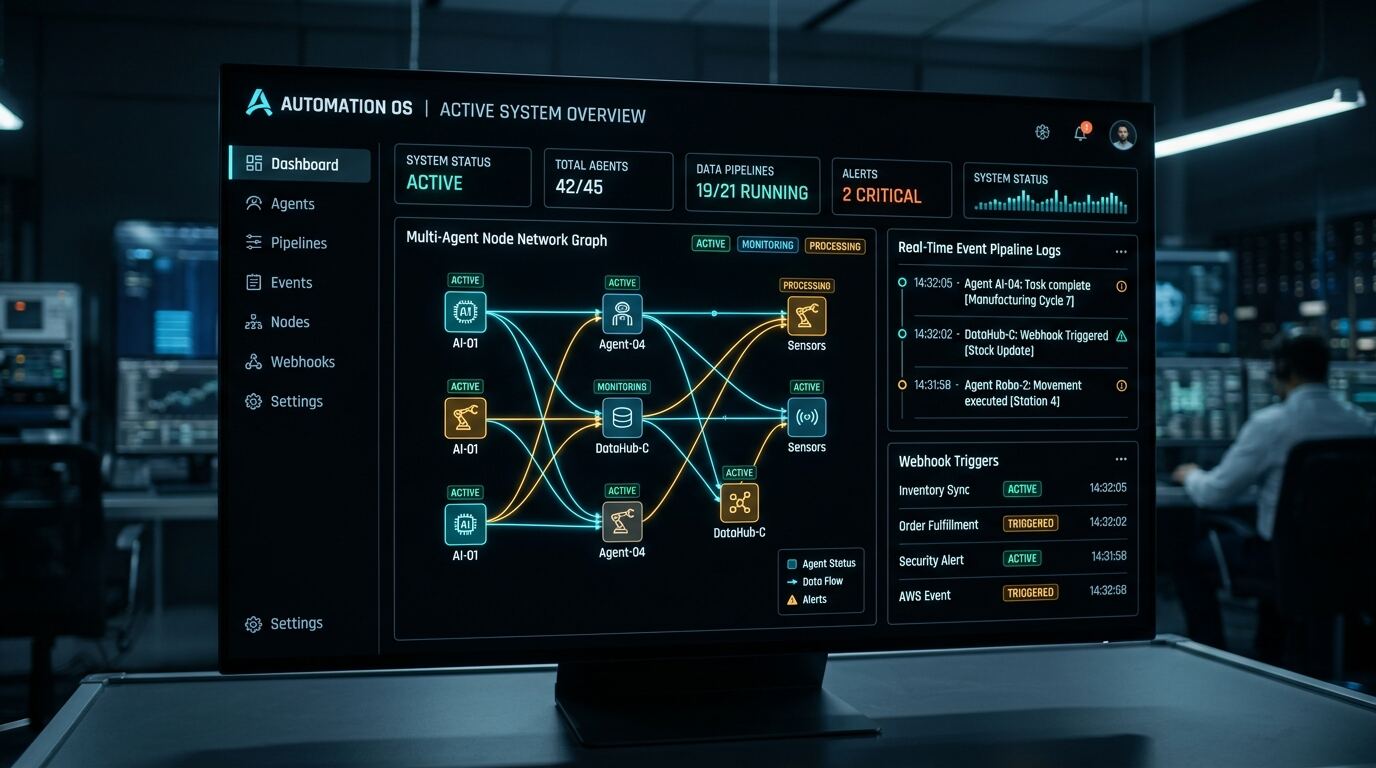
Automation OS — Active System Overview & Multi-Agent Network Graph.
Businesses operating on Automation OS replace chaotic disconnected tools with a rock-solid, production-grade system. Leads are contacted within seconds of inquiry, customer conversations are logged deterministically, and staff focus solely on closing deals rather than copying data across tabs.
Built by Shaurya Studio · the AI agency founded by Shaurya Singh